The 10 Best, Worst, and Most Improved States for Internet Speed in 2026
Speeds increased modestly nationwide, but major disparities remain

Aug 7, 2026 | Share 


Data and Research, Industry Exclusive/Entertainment
Internet speeds across the U.S. are faster in 2026 than they were in 2025, with an increase of 5.26%.
The overall increase was modest, but differences across states were stark. In Delaware, for example, you can download a two-hour 4K movie in less than 10 minutes at median speeds. But in Alaska, that same movie download takes more than 25 minutes at median speeds.
Some states posted year-over-year speed gains nearly ten times larger than the national average. In West Virginia, where speeds improved by more than 50%, this boost means you could download a Call of Duty update about 90 minutes faster in 2026 compared to 2025, assuming you were operating at median speeds in both years.
It’s nice to get time back rather than watching a progress bar, but faster download speeds also mean more bandwidth for connected devices, easier file management in the cloud, and better opportunities for telehealth, online learning, and remote work.
This report will cover the states with the fastest and slowest median download speeds, explain why median and mathematical average scores differ, and list the most-improved states of 2026. Scroll to the bottom for complete state-by-state data.
Key findings:
- Across the U.S., median download speeds increased from 125.35Mbps in 2025 to 131.94Mbps in 2026. That’s an increase of 5.26% year-over-year.
- Alaska has the slowest median speed in the nation at 73.42Mbps. That’s a 42.81% improvement year over year.
- Delaware holds the top spot for the second edition running, with a median download speed of 193.87Mbps.
- Average speeds were much faster than median speeds across the map, showing that some customers enjoy much faster speeds than their neighbors.
- The fastest states are in heavily populated states in the North and Southeast, while the slowest states are in rural states in the Midwest, Mountain West, and Pacific.
Internet speeds across America in 2026
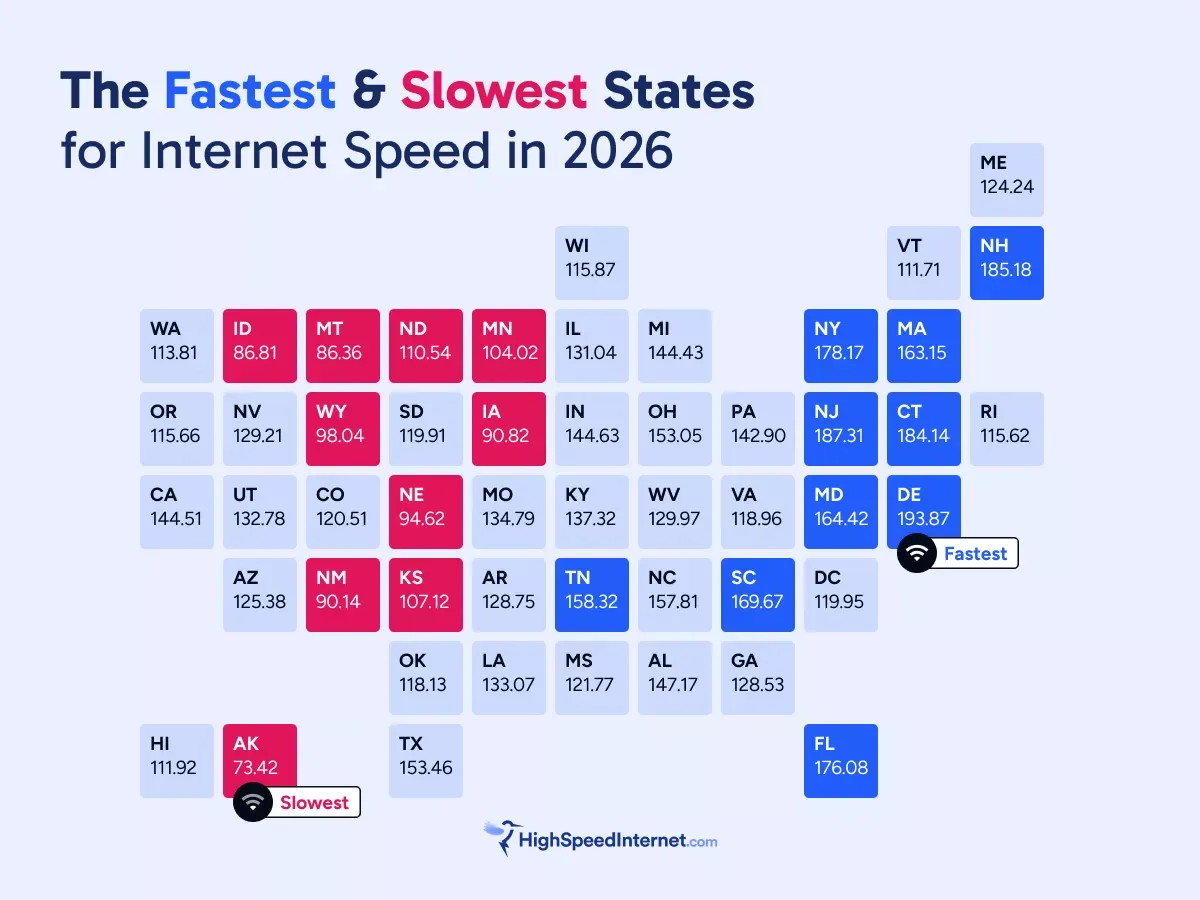
The median download speed in the U.S. is up by a little more than 5% compared to last year, and the median speed in 38 states is higher than it was in 2025. However, median recorded speeds were slower in 13 states.
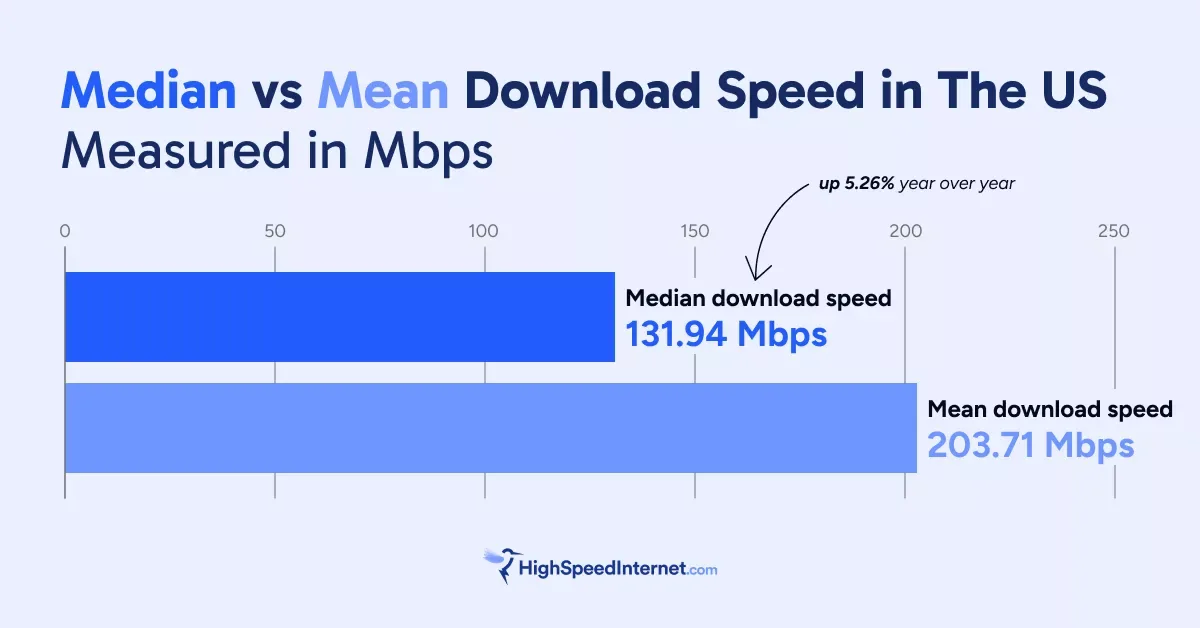
The mixed results make sense in light of the growth of 5G fixed wireless home internet. While faster than DSL and satellite (and fast enough for streaming and browsing), fixed wireless speeds are often slower than cable or fiber internet.
Even as 5G home internet has become more competitive, fiber internet now reaches more than 60% of homes, and cable internet providers (like Spectrum) are rolling out DOCSIS 4.0 upgrades market by market, which means faster upload and download speeds in every upgraded neighborhood.
In concert with these upgrades, plan prices are going down and advertised speeds are going up, as detailed in our 2026 Best Value Internet Provider report.
States with the fastest internet speeds
Delaware is the reigning speed champion for the second year running, with New Jersey, New Hampshire, and Connecticut close on its heels. Each of the top ten states clocked speeds faster than 150Mbps, more than 1.5X the FCC’s official broadband speed designation.
Each of these states has near-universal access to 100Mbps service, according to FCC data, and each is well-served by fully wired internet from major fiber providers such as Verizon Fios, large cable internet providers such as Xfinity, and small municipal co-ops and telephone companies such as EPB (Chattanooga’s municipal utility).
It means that most people logging onto the internet in these states have plenty of speed for file downloads, streaming in high-definition on multiple devices, and watching online lectures or work presentations.
Why mathematically average speeds outpace median speeds
Nationwide, average (mean) speeds are consistently higher than median speeds, skewed by a small number of ultra-fast connections. These outliers inflate the averages. While each of the top ten states had median speeds between 150Mbps and 200Mbps, they all had average speeds of faster than 200Mbps. Delaware again topped the list, leading at 250Mbps.
It’s a reminder that internet speed is specific to your connection, your home network equipment, your device, and even the time of day. Your neighbor with a 5Gbps fiber internet connection, a Wi-Fi 7 router, and an M5-powered MacBook Pro is always going to get faster speed test results than your neighbor limping along on a Wi-Fi 5 router and a Galaxy S22 on 300Mbps fiber internet.
Top 10 states with the fastest internet speeds
Here’s a look at our top 10 winners and how their median and average speeds compare.
| Rank | State | 2026 Median Download Speed (Mbps) | 2026 Average Download Speed (Mbps) |
|---|---|---|---|
| 1 | Delaware | 193.87 | 250.46 |
| 2 | New Jersey | 187.31 | 246.15 |
| 3 | New Hampshire | 185.18 | 244.26 |
| 4 | Connecticut | 184.14 | 248.80 |
| 5 | New York | 178.17 | 230.50 |
| 6 | Florida | 176.08 | 246.38 |
| 7 | South Carolina | 169.67 | 219.16 |
| 8 | Maryland | 164.42 | 242.65 |
| 9 | Massachusetts | 163.15 | 233.06 |
| 10 | Tennessee | 158.32 | 208.91 |
States with the biggest year-over-year speed gains
The two states with the biggest speed improvements year over year were West Virginia, up by 51.64%, and Alaska, up by 42.81%.
West Virginia’s median download speed increased to 129.97Mbps from 85.71Mbps. This speed makes it possible to restore a full 1TB cloud backup in about 17 hours, rather than the nearly 26 hours it would have taken the year before.
Alaska’s median speeds increased from around 50Mbps to nearly 75Mbps. That means downloading a 128GB photo library that used to take an Alaskan household about five and a half hours now takes less than four hours—a savings of an hour and 40 minutes. Internet service in America’s Last Frontier still isn’t fast, but it’s catching up.
While each of these states has been allocated funding as part of the $42.45 billion Broadband Equity, Access and Deployment (BEAD) program, no funded projects have yet been completed in any of our most-improved states.
Top 10 states with the biggest speed improvements in 2026
Here’s a look at states where internet speeds improved most over the last 12 months:
| Rank | State | 2025 Median Download speed (Mbps) | 2026 Median Download Speed (Mbps) | Year-over-year changes in download speed |
|---|---|---|---|---|
| 1 | West Virginia | 85.71 | 129.97 | 51.64% |
| 2 | Alaska | 51.41 | 73.42 | 42.81% |
| 3 | Vermont | 87.29 | 111.71 | 27.98% |
| 4 | New Hampshire | 148.21 | 185.18 | 24.94% |
| 5 | Illinois | 106.41 | 131.04 | 23.15% |
| 6 | Arkansas | 104.96 | 128.75 | 22.67% |
| 7 | Michigan | 119.99 | 144.43 | 20.37% |
| 8 | Indiana | 121.72 | 144.63 | 18.82% |
| 9 | Mississippi | 105.37 | 121.77 | 15.56% |
| 10 | New York | 154.18 | 178.17 | 15.56% |
States with the slowest internet speeds
In 2026, the nation’s slowest internet speeds are concentrated in the rural West and Midwest, reflecting decades of infrastructure disparity. Because it is both expensive and less profitable to serve sparsely populated areas, progress is a persistent challenge.
However, help is on the way: Half of the states with the worst rankings also rank in the top 10 for per-capita BEAD funding. Alaska tops the list with roughly $1,387 per resident, followed by significant investments in Wyoming ($603) and Montana ($580). While BEAD and its predecessor, the Rural Digital Opportunity Fund (RDOF), help subsidize these reach-out efforts, high connection costs often leave remote communities dependent on slower satellite or fixed wireless options.
Not everyone in these states has slow speeds, though. More heavily populated areas within these states have better infrastructure and more provider choice, and therefore faster internet speeds. The results are reflected in the significant difference between median and mathematically average speeds in each state.
Top 10 states with the slowest internet speeds 2026
Here’s our comprehensive list of the worst states for internet speed, highlighting the difference between median and average download speeds in the slowest states.
| Rank | State | 2026 Median Download Speed (Mbps) | 2026 Average Download Speed (Mbps) |
|---|---|---|---|
| 1 | Alaska | 73.42 | 143.47 |
| 2 | Montana | 86.36 | 140.69 |
| 3 | Idaho | 86.81 | 154.80 |
| 4 | New Mexico | 90.14 | 183.23 |
| 5 | Iowa | 90.82 | 163.91 |
| 6 | Nebraska | 94.62 | 172.01 |
| 7 | Wyoming | 98.04 | 168.57 |
| 8 | Minnesota | 104.02 | 168.04 |
| 9 | Kansas | 107.12 | 173.81 |
| 10 | North Dakota | 110.54 | 171.57 |
Note: BEAD figures cited in this data reflect original 2023–2024 allocations
In June 2025, the “Benefit of the Bargain” round scrapped the BEAD program’s fiber-first mandate and forced every state to re-select subgrantees based on lowest cost, shifting billions toward cheaper satellite and fixed-wireless options.
As a result, actual award totals have come in far below original allocations—roughly 46% of the original amount across the states tracked so far, with an estimated $21 billion left unclaimed nationwide. Per-capita BEAD figures cited here reflect the original funding baseline, not what states will ultimately deploy.
Full-speed ranking of all 50 US states (and DC) in 2026
| Rank | State | 2026 Median Download Speed (Mbps) | 2026 Average Download Speed (Mbps) |
|---|---|---|---|
| 1 | Delaware | 193.87 | 250.46 |
| 2 | New Jersey | 187.31 | 246.15 |
| 3 | New Hampshire | 185.18 | 244.26 |
| 4 | Connecticut | 184.14 | 248.80 |
| 5 | New York | 178.17 | 230.50 |
| 6 | Florida | 176.08 | 246.38 |
| 7 | South Carolina | 169.67 | 219.16 |
| 8 | Maryland | 164.42 | 242.65 |
| 9 | Massachusetts | 163.15 | 233.06 |
| 10 | Tennessee | 158.32 | 208.91 |
| 11 | North Carolina | 158.32 | 214.71 |
| 12 | Texas | 153.46 | 235.13 |
| 13 | Ohio | 153.05 | 211.28 |
| 14 | Alabama | 147.17 | 209.94 |
| 15 | Indiana | 144.63 | 218.82 |
| 16 | California | 144.51 | 233.99 |
| 17 | Michigan | 144.43 | 214.77 |
| 18 | Pennsylvania | 142.90 | 214.43 |
| 19 | Kentucky | 137.32 | 194.86 |
| 20 | Missouri | 134.79 | 210.59 |
| 21 | Louisiana | 133.07 | 214.21 |
| 22 | Utah | 132.78 | 210.44 |
| 23 | Illinois | 131.04 | 225.27 |
| 24 | West Virginia | 129.97 | 205.16 |
| 25 | Nevada | 129.21 | 211.71 |
| 26 | Arkansas | 128.75 | 208.85 |
| 27 | Georgia | 128.53 | 204.04 |
| 28 | Arizona | 125.38 | 199.54 |
| 29 | Maine | 124.24 | 196.26 |
| 30 | Mississippi | 121.77 | 197.46 |
| 31 | Colorado | 120.51 | 214.37 |
| 32 | District of Columbia | 119.95 | 204.88 |
| 33 | South Dakota | 119.91 | 171.20 |
| 34 | Virginia | 118.96 | 208.96 |
| 35 | Oklahoma | 118.13 | 214.89 |
| 36 | Wisconsin | 115.87 | 202.79 |
| 37 | Oregon | 115.66 | 211.23 |
| 38 | Rhode Island | 115.62 | 191.44 |
| 39 | Washington | 113.81 | 207.98 |
| 40 | Hawaii | 111.92 | 117.86 |
| 41 | Vermont | 111.71 | 201.56 |
| 42 | North Dakota | 110.54 | 171.57 |
| 43 | Kansas | 107.12 | 173.81 |
| 44 | Minnesota | 104.02 | 168.04 |
| 45 | Wyoming | 98.04 | 168.57 |
| 46 | Nebraska | 94.62 | 172.01 |
| 47 | Iowa | 90.82 | 163.91 |
| 48 | New Mexico | 90.14 | 183.23 |
| 49 | Idaho | 86.81 | 154.80 |
| 50 | Montana | 86.36 | 140.69 |
| 51 | Alaska | 73.42 | 143.47 |
The takeaway: Don’t wait for infrastructure; improve your equipment
The median speeds we discuss in this report help benchmark each state’s progress in closing the digital divide, but the disparity between median and average (mean) speeds makes it clear that some customers enjoy much faster speeds than others.
The first step in improving your own speeds is to run a wired speed test so you know your baseline. Then, evaluate your Wi-Fi equipment and consider upgrading because a better router or gateway means better performance on compatible devices. Finally, enter your zip code into an internet provider lookup tool to make sure you know all your options for plans and providers in your area.
There’s not much you can do about local infrastructure or the slow rollout of BEAD, but you can make changes to your home network that improve your speed test results and your quality of life.
Methodology
We analyzed the results of 4,727,224 speed tests taken on HighSpeedInternet.com’s speed test tool and app in all 50 U.S. states and Washington, D.C., between July 20, 2025, and July 20, 2026. If multiple speed tests were taken from the same IP address, we used only the highest results. To determine year-over-year change, we compared these results to those from the previous 12 months. We used the median download speeds in each state to determine which were fastest and slowest.
Note that the data in this report is not comparable to data offered in our previous state-level speed reports, which covered only mathematical average (mean) speeds.
FAQ about internet speeds in 2026
What is a median speed?
The median speed represents the middle value of all the speed test results, using only the fastest speed for any given IP address. Unlike an average (mean), the median is not skewed by a small number of extremely fast or slow results, making it a better indicator of the typical user experience.
Author - Chili Palmer
Chili Palmer covers home tech services, with a special focus on understanding what families need and how they can stay connected on a budget. She handles internet access and affordability, breaking news, mobile services, and consumer trends. Chili’s work as a writer, reporter, and editor has appeared in publications including Telecompetitor, Utah Business, Idaho Business Review, Benton Institute for Broadband & Society, and Switchful.com.
Editor - Jessica Brooksby
Jessica loves bringing her passion for the written word and her love of tech into one space at HighSpeedInternet.com. She works with the team’s writers to revise strong, user-focused content so every reader can find the tech that works for them. Jessica has a bachelor’s degree in English from Utah Valley University and seven years of creative and editorial experience. Outside of work, she spends her time gaming, reading, painting, and buying an excessive amount of Legend of Zelda merchandise.
Related Posts