Bezos Announces Another Starlink Competitor
Sure, other billionaires own LEO satellite providers, but how many own two?

Feb 12, 2026 | Share 


News, Technology
Jeff Bezos is building a Starlink competitor. Wait, hasn’t Bezos been trying to build a satellite internet company for years? You’re probably thinking about Amazon Leo (formerly Project Kuiper). In late January 2026, Jeff Bezos’ space travel company, Blue Origin, announced that it was creating a low-Earth Orbit (LEO) satellite constellation to compete with the likes of Starlink and OneWeb.
Different satellites. Different company. Same billionaire. Confused? Don’t worry. We’re going to straighten out the details and what it means for the average internet user.
On this page:
What is TeraWave? | When will it be available? | Why should we care? | More resources
On this page:
What is TeraWave?
TeraWave is a planned satellite constellation designed to deliver symmetrical data speeds of up to 6Tbps (6,000,000Mbps). It will consist of satellites in low-Earth orbit (LEO) and medium-Earth orbit (MEO), connecting areas that lack high-speed fiber connections that could handle the same amount of data.
Unlike Amazon Leo, which is designed for residential internet customers, TeraWave is geared toward enterprise and government customers that need higher throughput. Other important features planned for the system include symmetrical upload and download speeds, redundancy to limit network disruption, and the ability to scale rapidly with the needs of a business.
The planned constellation will consist of 5,280 LEO satellites, delivering speeds up to 144Gbps, and 128 MEO satellites, which will be able to provide speeds up to 6Tbps via optical connections.
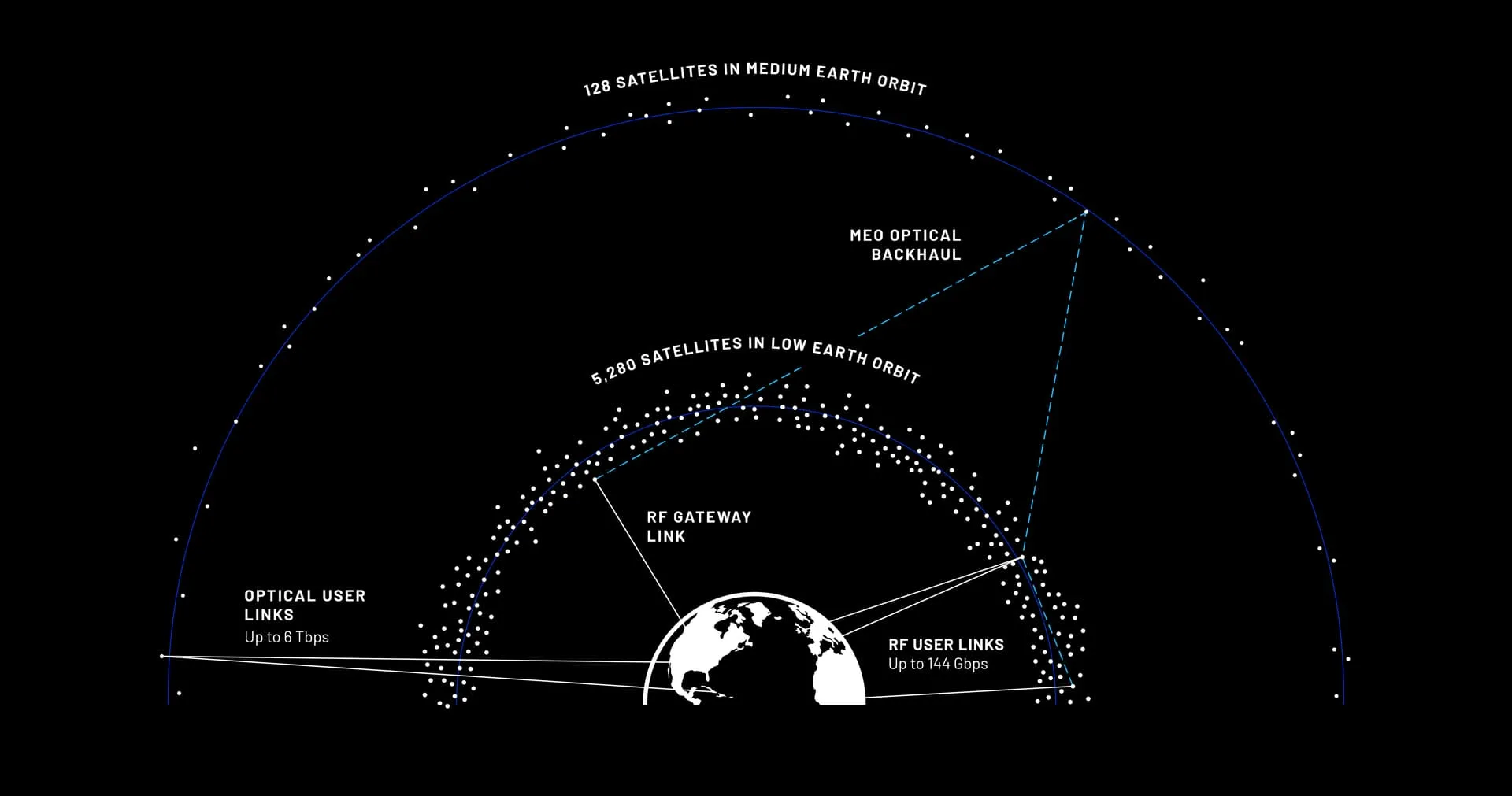
In order to offer so much bandwidth to each customer, TeraWave can only split its resources so many ways. The company estimates that it can serve a maximum number of about 100,000 customers, as opposed to the millions of residential customers currently served by satellite providers. While this limits TeraWave’s potential customer base, these kinds of big contracts can be very profitable, and Blue Origin isn’t the first company to cater exclusively to enterprise-level customers.
When will TeraWave be available?
Deployment of TeraWave is currently scheduled to begin toward the end of 2027. The company has given no estimates on when it will be fully functional, but if we compare it to other LEO constellations like Starlink and Amazon Leo, we can expect the rollout of the constellation to take about three years.
On the one hand, LEO satellite technology has come a long way since the first Starlink satellites were launched almost a decade ago. With Bezos’ experience with the production of Amazon Leo satellites, it’s possible the deployment will progress more efficiently than with previous constellations. Blue Origin also operates its own rockets, which is an advantage it has even over Amazon Leo.
On the other hand, there are considerable hurdles that TeraWave will have to overcome. Although Blue Origin can rely on its own rockets, there’s a lot more demand for payload space on other rocket launches. With multiple competing communication companies across the globe launching their own satellites, buying additional space on other rockets will be more difficult.
TeraWave will also have to deal with technical challenges in achieving multi-terabit connections for its users. Starlink’s addition of laser crosslinks to its satellites caused some delays to its launch schedule back in 2021 as the company sought to decrease latency in its network. While TeraWave’s surface-to-orbit optical links are a planned part of its satellites from the start, this technology has never been used at this scale before. In such a competitive and fast-moving technical field, it wouldn’t be a surprise to see additional refinements as deployment gets underway.
In any case, I would estimate that we won’t see TeraWave up and running before 2030 or 2031.
Why should we care about TeraWave?
With no plans to offer residential internet, TeraWave probably won’t impact many of us directly. Still, there are some reasons to keep an eye on what’s happening with Blue Origin’s new satellite constellation.
TeraWave’s target customers are large organizations, making it more comparable to companies like OneWeb and Logos Space than Starlink, though the latter is also chasing those lucrative government and enterprise contracts. Competition in tech spaces is always a breath of fresh air, and Starlink is already touting the speeds of its next-generation laser-networked satellites. Both companies will have to continue to innovate in order to avoid being left behind.
With its high-throughput MEO satellites, TeraWave would also be well-positioned to serve as a wireless backhaul for smaller internet service providers (ISPs) in remote regions. OneWeb, for example, doesn’t serve residential customers, but it does provide internet service to small ISPs, airlines, and other companies that then offer internet service to their customers. Blue Origin hasn’t listed any of these use cases specifically, but they aren’t out of the realm of possibility.
Even if TeraWave doesn’t interact so directly with the consumer broadband market, it doesn’t mean that it won’t impact the average internet user. A satellite connection with the bandwidth of an internet backbone could be used for support during a natural disaster, provide redundancy to overloaded ground infrastructure, or bring a large workplace online while fiber infrastructure is still being built. In the future, services like TeraWave could be in the background of everything we do online in the same way that cloud computing is today.
Author - Peter Christiansen
Peter Christiansen writes about telecom policy, communications infrastructure, satellite internet, and rural connectivity for HighSpeedInternet.com. Peter holds a PhD in communication from the University of Utah and has been working in tech for over 15 years as a computer programmer, game developer, filmmaker, and writer. His writing has been praised by outlets like Wired, Digital Humanities Now, and the New Statesman.
Editor - Jessica Brooksby
Jessica loves bringing her passion for the written word and her love of tech into one space at HighSpeedInternet.com. She works with the team’s writers to revise strong, user-focused content so every reader can find the tech that works for them. Jessica has a bachelor’s degree in English from Utah Valley University and seven years of creative and editorial experience. Outside of work, she spends her time gaming, reading, painting, and buying an excessive amount of Legend of Zelda merchandise.
Related Posts