Is CenturyLink Down?
Find out if you're in a CenturyLink outage, and get tips on getting back online fast

Mar 23, 2026 | Share 


Brand Guides, Equipment Guides, Internet Outage
If CenturyLink is your internet provider and you’re having trouble connecting, start with an internet speed test to see if you’re in an outage.
First, reconnect to your CenturyLink Wi-Fi. Then, click below.
Download speed
000 Mbps
Upload speed
000 Mbps
Latency (ping)
00 ms
Jitter
00 ms
What to look for in your speed test results
If you’re in a CenturyLink outage, the speed test will say “Loading,” and a light blue circle will spin, but you won’t get any results.
If you get results that show download speeds, upload speeds, and latency, though, you aren’t in an outage.
You could still be having problems, of course. Ideally, you should get speeds reasonably close to what your plan promises, but you need the following for a healthy connection:
- Download speeds of at least 20Mbps
- Upload speeds of at least 3Mbps
- Latency of less than 100 ms
In this guide:
Troubleshoot | Get a refund | Leave a review | Decide whether to switch | My take | FAQs
In this guide:
How to troubleshoot CenturyLink connection issues
If you get stuck on “Loading” on the speed test above, go through the steps below one by one.
Step 1: Try using a different phone, tablet, or computer to access your CenturyLink network.
Step 2: Check all the power cords and Ethernet cables going to and from your internet equipment.
Step 3: Check for notifications on your CenturyLink app or account.
Step 4: Restart or power cycle your internet equipment (modem, router, or gateway combo).
Step 5: Delete your CenturyLink Wi-Fi network on your device, then add it again.
Check the lights on your CenturyLink equipment
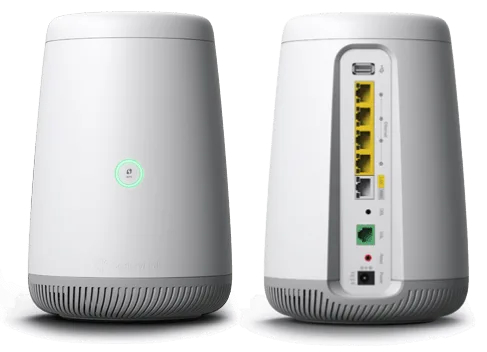
C4000 Series modem/router from CenturyLink. Image sourced from CenturyLink.net and is the property of Lumen.
You can check for an incoming internet signal by examining the lights on your fiber or DSL equipment.
CenturyLink leases a few different modem types, but the C4000 model is the most common. The LED status light on the front will change colors, depending on the connection status. Here’s what the colors mean:
- Blinking blue: Searching for network
- Solid blue: Connection established
- Green: Connection made
- Amber: Setup incomplete
- Red: Connection failure
- Orange: Firmware upgrade in progress

Pro tip:
CenturyLink refers to all its internet equipment as “modems” but they’re technically gateways, which combine the functionality of a modem and router (for DSL internet) or an optical network terminal and router (for fiber internet).
Learn more and troubleshoot your CenturyLink connection
Still can’t get online? Contact CenturyLink
If you’ve tried all the steps above but still can’t get online, try CenturyLink’s new automated tool to test your line and equipment. If you’re in a widespread outage, that’s the easiest way to find out. You’ll see a notification like this:
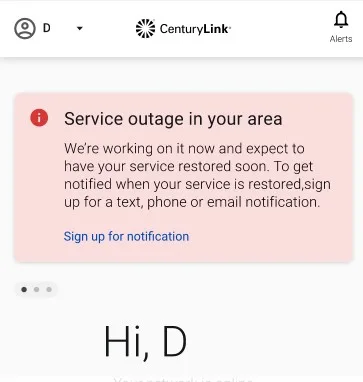
If there is an outage, sign up for a notification so you know when the service is back up. If there’s no widespread outage but the automated system finds a problem with your individual line or your equipment, the tool will set up an appointment for you.
If you can’t get to the tool online or on your CenturyLink app, contact the repair department by chat or by calling +1-800-244-1111. You’ll need to enter the phone number of the primary account holder to get through the phone tree.
Find more ways to contact CenturyLink customer service.
Does CenturyLink offer refunds?
CenturyLink offers bill credits for outages that last 24 hours or more. To get the credit, you need to report it by either calling +1-800-244-1111 or using the company’s automated troubleshooting tool.
Leave a review about your CenturyLink service
Are you a CenturyLink customer? Tell us what you think about the service.
Your reviews help us give better recommendations.
How CenturyLink compares
CenturyLink competes against every type of internet: fiber, cable, 5G fixed wireless home internet, and even satellite. What you can get depends on which providers operate in your area.
In most cases, fiber internet is our top pick (whether you get it from CenturyLink or a competitor). If you can get only DSL from CenturyLink, the choice is harder.
CenturyLink DSL vs. T-Mobile 5G Home Internet: If you can’t get fiber internet from CenturyLink, you’ll probably be happier with T-Mobile 5G Home Internet. Monthly prices for the cheapest plans are about the same between providers, but T-Mobile offers free equipment and installation, plus faster max download speeds. Those speeds can slow down if the network is heavily congested, but they may still be faster than your DSL speeds.
CenturyLink DSL vs. Xfinity: Go with Xfinity. There’s a wider range of plans, including faster speeds for lower monthly prices. Xfinity also offers free internet equipment for the first two years. Best of all, though, cable internet is more reliable than DSL internet.
CenturyLink DSL vs. Spectrum: If it’s a choice of DSL from CenturyLink vs. cable or fiber with Spectrum, go with Spectrum. You’ll appreciate the reliability, cheaper plans, and automatic refunds for outages that last more than 24 hours.
CenturyLink DSL vs. Rise Internet: Rise Internet offers traditional fixed wireless internet service, while CenturyLink offers DSL (and fiber internet, in some places). If CenturyLink offers DSL where you live, your choice should depend on how far your home is from the nearest tower or DSL terminal, as that will determine your speeds. If you’re not sure, choose CenturyLink if you have working telephone wiring in your house, but choose Rise Internet if you don’t.
Read more CenturyLink comparisons

Tired of slowdowns and outages with CenturyLink?
Enter your zip code to find other home internet providers where you live.
My take: If CenturyLink is slow, shop for alternatives
If you’re having problems with your CenturyLink connection and it’s connected via DSL rather than fiber, it makes sense to shop for alternatives. DSL infrastructure is old and may require frequent repairs. Even if your lines are in good shape, your signal slows down the further you are from your local terminal.
If you can’t get fiber internet, 5G home internet is a good alternative. The tech is less susceptible to congestion-related slowdowns than it used to be, and latency is improving all the time. Our top pick for a wireless connection is T-Mobile 5G Home Internet. If your address doesn’t qualify, consider shopping for 5G home internet from Verizon or AT&T. All three options give you discounts when you bundle with mobile phone service, and there are no data limits or equipment fees.
Read more about CenturyLink
CenturyLink outage FAQ
How do I know if CenturyLink is down in my area?
Why is my CenturyLink internet slow?
Why is my CenturyLink Wi-Fi connected, but I don't have internet?
Why is my internet light red on my CenturyLink modem?
Author - Chili Palmer
Chili Palmer covers home tech services, with a special focus on understanding what families need and how they can stay connected on a budget. She handles internet access and affordability, breaking news, mobile services, and consumer trends. Chili’s work as a writer, reporter, and editor has appeared in publications including Telecompetitor, Utah Business, Idaho Business Review, Benton Institute for Broadband & Society, and Switchful.com.
Editor - Jessica Brooksby
Jessica loves bringing her passion for the written word and her love of tech into one space at HighSpeedInternet.com. She works with the team’s writers to revise strong, user-focused content so every reader can find the tech that works for them. Jessica has a bachelor’s degree in English from Utah Valley University and seven years of creative and editorial experience. Outside of work, she spends her time gaming, reading, painting, and buying an excessive amount of Legend of Zelda merchandise.
Related Posts